The Australia Network reports that the crew from CEDAC have found unacceptable levels of borax and formalin in Cambodian food. Borax is used as an all-purpose preservative/tenderiser despite causing a range of problems ranging from the ever-popular nausea through to complete kidney failure and death. Formalin is also used as a preservative for meat, fish and human corpses. From the network:
A specialist in chemistry and food from the Royal Academy of Cambodia, Chek Sothahas, has found between 41 and 80 per cent of food products in Cambodia contain dangerous substances.
The Cambodian Centre for Study and Development in Agriculture says a union would enable consumers to demand better quality assurance measures for food products.
Yang Saing Koma, director of the centre, says consumers should call on producers and businesses to take responsibility for the health of Cambodia.
Research by Ms Sothahas has indicated borax and formalin, a substance made of formaldehyde and water, was found in products such as sausage, dry fish, seafood, noodles and meat balls.
It was only a matter of time before someone else picked up the gauntlet: Nyam Penh is blogging food from Phnom Penh.
CARMICHAEL: So, if I were a Czech person walking in here today, I would have a Clouded Leopard Kingdom pilsner, and it would taste pretty much like what I would get back at home in Prague?
HAUPENTHAL: We try to think so.
Congratulations to Kingdom Brewery for launching another Asian pilsener and having the sheer hubris to use Comic Sans on their website. Robert Carmichael from Radio Australia has the interview. It is no mean feat to get this far: Kingdom are only the second microbrewer in Cambodia and CEO Peter Brongers deserves some credit for pulling together the funds to get this started, regardless of how the beer tastes. As the interview mentions, brewing is the easy part; it’s the marketing that’s the rub. Any tasting reports?
Much like this blog, Phnom Penh dive bar Alley Cat recently celebrated their fourth anniversary. That’s 70 years old in Cambodian bar years, managing to outlive much healthier bars, subsisting on a diet of Mexican and gigantic hamburgers.

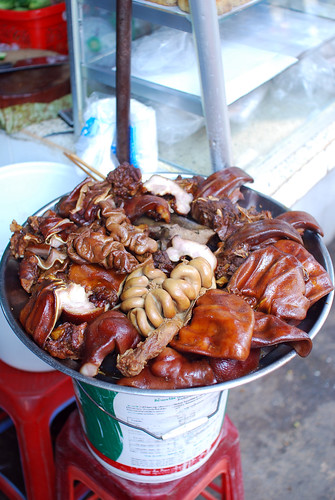
The true secret of the pig is not only that you can eat every part of the animal, but you can do so via barbecue. Spotted at Central Market, Phnom Penh.
Think you’ve got what it takes to make a low-cost watery Asian pilsener in an industrial setting? Cambodia’s newest brewing group is hiring. From Probrewer:
Kingdom Brewery (Cambodia) Ltd., Southeast Asia’s youngest boutique brewery is seeking a Brewer to join our team in Phnom Penh, Kingdom of Cambodia. Responsibilities are recipe formulation, production of beer, QA/QC, stock management, packaging, distribution scheduling, maintenance of plant equipment general upkeep of the main brewery and other associated duties including training of the Cambodian production staff.
We look for a brewer who is fit with a hard work, hands on ethic and who is able to handle people of a very different cultural background. What we offer is a competitive salary and a very pleasant working environment.
Get your curriculum vitae through to ceo@kingdombreweries.com
Via DAS. Market vendors at the Russian Market (Psar Toul Tom Poung) have just received the eviction call. Diana from Cambodian recycled bag vendor, Bloom writes:
I got a call from the Bloom manager in Phnom Penh this morning. Vendors at the Russian Market, where we have a stall, were told the government was going to shut down the market.
We have heard similar rumours for the last year or more, that the market would be closed for either (a) renovations or (b) relocation. In fact, the landlady at our former shop sold the shop, which was on the outside of the market, because she was told only shops inside the market would qualify for compensation. Shops on the outside are not considered part of the market, it seems.
There was a sign up at the Russian Market a few years ago with an image of a market eviscerated of any local character, suggesting that the wave of gentrification was about to swamp the market, but at that point in time it looked as likely as motodops being replaced by flying cars.
Cheers to Christopher Shay for the interview.